


The Lever Approach: How Austin Added Housing by Focusing on What It Could Control
To address the city's severe housing crisis, Austin identified three regulatory levers—permitting reform, land development code changes, and zoning amendments—that city government could immediately control, generating measurable results including 436 new units in the first year and HOME units priced 53% below traditional single-family homes.
Housing is consistently one of the biggest challenges a city faces; there’s not enough affordable housing, there’s overwhelming blight, too many evictions, skyrocketing rents and housing costs – the multiple, overlapping and interconnected issues can appear overwhelming and often seem outside city government's control. But a new approach in Austin is breaking down the problem and offering a framework for tackling the issue. Rather than asking "how do we fix housing," city leaders are instead focusing on "where can we pull the levers we already have?"
Mayor Kirk Watson came into office in 2023, having served as mayor once before, from 1997 to 2001. In the years since his first term, the city had changed dramatically. Between 2019 and 2023, Austin metro home prices were up 43% and the city experienced a population surge, in particular during the COVID-19 pandemic. Entering office during a historic housing crisis, Mayor Watson and his team immediately focused on lowering rental burden and increasing housing supply.
To do this, the Mayor’s Office took in the whole scope of housing, to see where local government already had a role and where they could affect different points in the process. Alexis Garcia, a policy advisor for Mayor Watson whose portfolio includes zoning and land use, has been central to this work since the beginning. According to Garcia, zoning, permitting, and development regulations were three areas that constrained new housing supply — but also represented areas where the city could exert direct influence.
Lever One: Permitting Reform
Identifying the first lever was a relatively direct process, since it came from community input.
“Developers, developer representatives, anybody who was trying to develop a piece of property was calling our office,” said Garcia, “We were fielding complaints left and right about how their permit was taking two years at this point [and] they were taking on the holding costs.” The city found that the holding costs, which include taxes or maintenance fees paid by developers, were adding up over the months and years it took to get a permit; by the time the housing was ready to lease, all that cost factored into the rental prices.
“That was actually one of the biggest contributors to the cost of housing, and especially these big multi-families,” reported Garcia. Knowing this was a prime area to lower costs through process improvement, Mayor Watson engaged the consulting firm McKinsey to conduct an audit of the permitting system. This revealed that a single site plan could have up to 1,500 touchpoints across departments.
“One of the main things that we realized throughout the process was that there wasn't enough communication between people and departments who are reviewing the applications,” said Garcia, so the City Manager's Office led an effort to bring all departments and stakeholders together to address this. By bringing everyone into the same room and reviewing the findings, they could figure out where there were holdups, duplicative work, or unnecessary steps.
In the most recently published reports, the city had an increase in site plan permits issued compared to previous quarters, and fewer than average number of days spent in the Completeness Check stage. The city publishes monthly public-facing metrics on the Development Services Department (DSD) website, complete with a Site Plan Process Tracker. The Tracker shows cases in active site plan review, from 2020 to present, to provide “project updates to applicants from application submission to case closure.” It also shows how much time a plan spends at each stage of review, which helps the city identify and correct any slowdowns or unnecessary steps. According to Garcia, DSD also introduced artificial intelligence (AI) in some services, such as an initial completeness check when an applicant first submits an application, which saves staff time and reduces delays by catching incomplete applications.
Lever Two: Land Development Regulation
The permitting work uncovered the next lever; during the process review, the consulting team validated city findings that multiple conflicting or unclear code requirements contributed to longer review times. The city team then identified compatibility as the first target. Given the rapid expansion and population growth, many older regulations were written for a smaller, less dense version of Austin.
“We’re basically retrofitting a city at this point,” explained Garcia, “for the amount of people that came in and the different industries that have been coming in…we're a completely different city than what we used to be.” One example she gave was the previous “compatibility standards,” which regulated the distance between tall buildings and single-family homes. Now, compatibility ends at 75 feet from a triggering property instead of the previous 540 feet; the old standard constrained the development of multi-family buildings in the city center, where many residents wanted to live. This meant less housing in desirable areas, sending costs soaring in the city core.
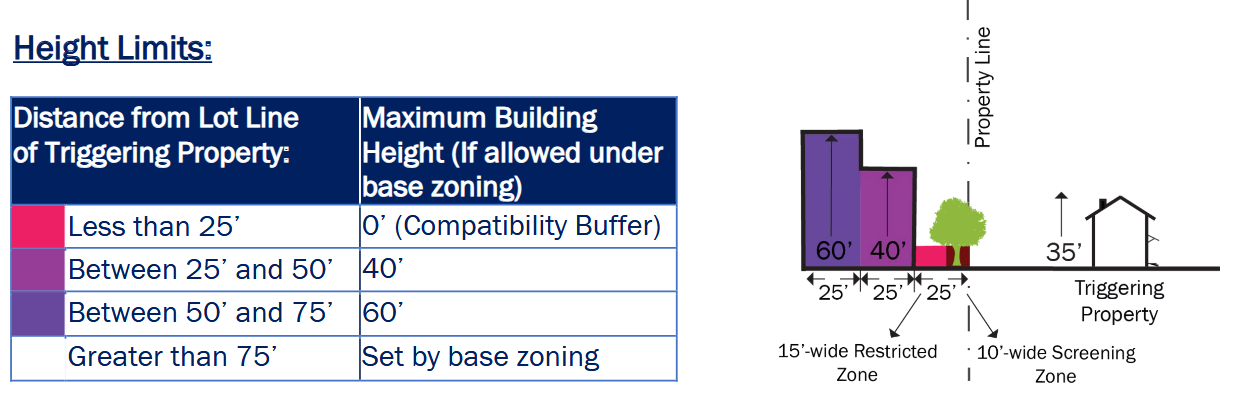
By cleaning and streamlining the code and changing the compatibility standards, the Planning Department estimated that the city could unlock up to 82,000 additional units of residential housing – without needing to rework the entire regulatory framework.
Lever Three: Zoning Codes
Alongside the previous work, the Mayor’s team was working on another lever. While several previous attempts to overhaul the land development code failed, Garcia highlighted the current success under Mayor Watson; rather than attempting to tackle the whole code, the Mayor's team made a strategic decision to pull out one piece for amendment. Thanks to the efforts of former councilmember Leslie Pool, who wrote the initial language for the Home Options for Mobility and Equity (HOME) initiative with the Mayor’s Office, Mayor Watson was able to push the collaborative amendment over the finish line. By focusing on a specific lever, the Mayor’s Office could conduct focused coalition building and community engagement – and avoid wading into a full code overhaul.
Before anything was drafted, Garcia and her team, in coordination with city staff, held town halls at libraries, sent planning staff into neighborhoods to talk with residents, and held open opportunities for Austinites to speak at council. She described meeting with “advocacy partners, urbanists, as many people as I could talk to," which "really influenced the way that we were drafting the policy."
As Phase One of HOME, the rewrite addressed “three units on one lot,” which allows infill development on Austin's traditionally large lots; for decades, the minimum lot size for a single-family home was 5,750 square feet. By redefining “single-family home,” homeowners and developers can now build up to three housing units on one parcel. Garcia shared that in the first year, the city added 436 new units.
The Mayor's Office took concerns about gentrification and displacement seriously, with a requirement for a yearly HOME report that specifically tracks those issues. The first report found HOME projects spread across the city, assuaging concerns that developers would concentrate new units in low-income areas and lead to gentrification. Additionally, the ordinance prioritizes using existing space and includes a preservation clause that offers developers more flexible regulations if they choose to keep the existing structure on a property and build behind it. Data from the first HOME report showed no increase in demolition permits, meaning developers were not buying and tearing down existing homes but instead building on vacant or underused portions of lots.
In April 2026, the Austin Board of Realtors released a report that found “the median sales price of a unit built under HOME Phase One was 53% lower than a traditional single-family home built and sold during the same time period.” While the actual dollar amount is around $750,000, which Garcia described as “still much higher than most people can afford,” that cost is far below the $1,580,000 median price for a single-family new construction house. “It's encouraging for us when we look at that,” she said, “It'll take years in order for it to balance into prices but seeing the difference between what a traditional is selling for and what a HOME unit is selling for…it’s been exciting to see the results.”
Pulling the Lever isn’t the End
The work doesn’t stop when the lever is activated; Austin is continuing to measure what’s working and what isn’t, to inform the next round of fixes. For DSD, the monthly permitting metrics keep the process accountable and adaptable, and the city is still reviewing conflicting or outdated zoning regulations. Additionally, the city council recently passed the HOME Improvements resolution that identified and directed staff to work on some of the sticking points or areas for improvement in the HOME Initiative.
Seeing the successes of this levered approach has empowered the city team to tackle another reform, what they’re calling the “missing middle.” This is another zoning lever that surfaced during the work on the land development code, which aims to address the lack of four- to 16-unit developments within neighborhoods. For several decades, the Land Development Code prioritized single-family homes or large apartment complexes, leading to sprawl and long commutes.
Garcia hopes that pulling this lever will open up medium-density housing, such as townhomes, cottage courts, and small multi-unit buildings, as well as transit-oriented mixed-use development. “It’s another way to create more of that neighborhood feel without getting rid of our single-family homes, because [that’s] one of the joys of Austin,” she said, “there’s a quiet walkability and everyone should have access to that.”
Garcia sees this as a natural extension of the city's evolving approach. “The city is exercising that change muscle," she said, and the success of HOME has made the team ready to take the next step; its success also represents a cultural shift, with more interest in, and appetite for, housing work. Austin is demonstrating that each lever pulled makes the next one easier to reach.
About the Author
Betsy Gardner

Betsy Gardner is the editor of Data-Smart City Solutions and the producer of the Data-Smart City Pod. Prior to this, Betsy worked in a variety of roles in higher education, focusing on deconstructing racial and gender inequality through research, writing, and facilitation. She also researched government spending and transparency at the Lincoln Institute of Land Policy. Betsy holds a master’s degree in Urban and Regional Policy from Northeastern University, a bachelor’s degree in Art History from Boston University, and a graduate certificate in Digital Storytelling from the Harvard Extension School.