


Driving Clean Streets with Data
GIS Lessons from Los Angeles
Seven years ago, the Data-Smart team covered a unique program in Los Angeles, the Clean Streets LA initiative called CleanStat, that was “turning dirty streets clean through comprehensive open data mapping.” In the near decade since this program launched, there has been exceptional growth in this area, eventually leading to the official formation of the Livability Services Division (LSD) in June 2019. This Division combines the existing CleanStat system, Citywide Receptacle Collection and Illegal Dumping program with the new Mobile Hygiene Unit program and the “revamped homeless encampment clean-up service under the Comprehensive Cleaning and Rapid Engagement (CARE and CARE+) program model.”
“CleanStat is really a data-driven deployment of resources,” said Rodell Zorilla, a Geographic information System (GIS) Supervisor for the city of Los Angeles’ Bureau of Sanitation and Environment (LASAN), which oversees the LSD. “One example is public street receptacles; with the litter data that we collect, we're able to identify then deploy receptacles based on the data, in conjunction with council offices input. We propose deployment locations based on the litter data, and the council offices review and provide us a list of locations where they want public street receptacles,” he explained. With the expansion of services, thanks to the formation of LSD, CleanStat is no longer the only program that utilizes data to effectively target LASAN resources.
Together with the Chief Environmental Compliance Inspector Salvador Rosales, Zorilla outlined the ways in which LSD creates and maintains public cleanliness, while improving livability in a city of 4 million residents.
Be Intentional with Data
“CleanStat led to everything else,” said Rosales, “it was the entry point and then, by being successful, branched out into so many different things.” CleanStat gathers street-by-street cleanliness data, assessing things like litter, illegal dumping, mattresses, white goods, shopping carts, and weeds. The data are used to score the streets, from 1 (clean) to 3 (not clean). While there are intersections between the multiple programs, Zorilla and Rosales both emphasized that each one is separate with a focus on program-specific data.

For example, in addition to the criteria used to calculate the cleanliness of the streets listed above, the street-level LSD workers also collect data on homeless encampments which are used to deploy services. Yet that data is specifically around density and location of encampments — like a count of tents and shelters in an encampment — rather than counting individuals. “We don't count people, we count the number of items in the public guided way,” said Rosales “So it tells us where we can deploy the mobile hygiene unit (MHU), for example.” There are also regular rotations, so guests know where the MHU will be providing bathroom and shower access.
Zorilla pointed out that encampment presence does not affect a street’s CleanStat grading. Locations of encampments can be indicated on the CleanStat map, and much of the data collected by LSD can be layered, but the teams are also able to utilize very specific, targeted data for different service delivery.
Another way that data is used intentionally is through the deployment of signs and local ambassadors. For example, if there is significant data indicating that one area routinely has illegal dumping, city workers can install signs in those places. The signs serve two purposes; one, to let would-be dumpers know that they can — and should — call to request a pickup, and two, to let bystanders know that they can call to report illegal dumping and have it removed. The LSD team also used data to determine where local ambassadors can be deployed to distribute informational anti-dumping flyers door-to-door.
Having such specific, deep data helps the LSD team understand the root causes of issues around trash, illegal dumping, and health hazards on the street while addressing these by allowing proactive illegal dumping collections, deployment of public street receptacles, and strategic deployment of other city services in addressing the broader scope of issues faced by the city.
Engage Residents in the Process
Another important complement to the intentional data is the engagement with residents; not only is that engagement guided by data, as in the sign and flyer distribution mentioned above, but being in the community with residents is also another opportunity for quantitative data gathering and trust building.
Mayor Karen Bass, who took office in 2022, emphasizes the customer service aspect of government which aligns well with the frontline work done by LSD. “We want to be invited to public meetings,” said Zorilla, “since, when we provide residents with data, we work together and collaborate more.” In a community meeting, Zorilla showed residents of the Watts neighborhood the data maps that can help them decide how and where to deploy resources. The community, in response, provided additional locations and conveyed information to further improve the services provided to them. This started a bigger conversation about combining the quantitative with qualitative data, and the importance of utilizing services like 311 to call in and report trash. “City government is so removed in a lot of ways,” said Rosales, “but it shouldn’t be us against them.”
Another facet of community engagement is around the persistent issue of homelessness in Los Angeles. With tens of thousands of unsheltered residents, the role of LSD in this crisis can be challenging for some residents to understand. “There are so many variables that go into the delivery of a cleanup,” said Rosales, a reality that not many know about without LSD engagement efforts. “Anytime I present on homeless encampment services, people are like ‘I had no clue’” he explained “because it's such a robust process and so much work had to be done just to get to that point.”
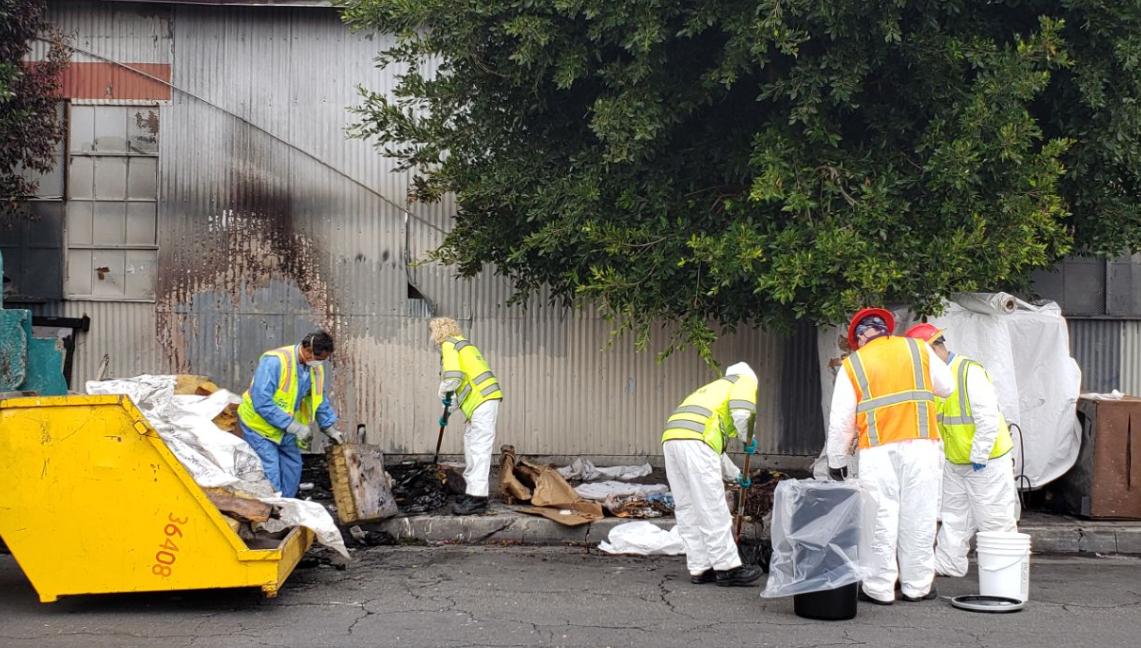
According to Rosales, a single encampment report “activates the entire system — a whole slew of steps that need to be taken just from service delivery.” LSD street teams partner with other city departments and groups, to provide wraparound support services. Since LASAN focuses on sanitation and environment, frontline workers do deal with any kind of hazardous drug waste, health hazard, and human waste in and around encampment sites. They also deal with unsheltered folks’ personal effects.
“Any encampment is filled with the items you’d find in your own home,” said Rosales, so they have to methodically work through the items in the public way and then make a call on which “bucket” to place items in: landfill, hazardous waste, or storage facility. Pursuant to the municipal code, Rosales’ team leaves a notification on location, detailing what they picked up and the storage facility information, so residents can reclaim their possessions that were removed.
Support LASAN Workers
This is a physically and psychologically challenging job. Traveling all over the city, dealing with everything from biowaste to drug paraphernalia, takes a toll on LSD employees. Rosales, Zorilla, and the rest of LASAN leadership are dedicated to making things as efficient, thoughtful, and streamlined as possible for the frontline workers. One of the biggest improvements has been upgrading the on-site process through better technology.
For a long time frontline workers would manually create reports, writing in a field notebook and using their phone to capture pictures and videos, which were then stored across multiple systems like Excel or Google Docs. Preparing written reports was difficult to do on site, so many employees documented what they could and then returned to the office to finish their reports for every location. According to Rosales, this wasted a significant amount of staff time and led to missing or incomplete reports as employees struggled to catch up on documentation for multiple sites during overtime.
Now, thanks to a system overhaul, reports are entirely digital; they can easily be completed on site, are instantly accessible by multiple viewers, facilitate data sharing with other departments, and use built-in automation to save employees time. Thanks to ArcGIS apps like Survey123 and Experience Builder, multiple forms are now combined into one single source that a worker fills out to generate a report. “As a multiprocess with multiple agile tools, it's now a smooth process.” said Zorilla, one of the tool’s creators, “This created the ability to scale certain tasks that before required a team to compete; now those can be automated, streamlined, and those teams can focus on other tasks.” A digitized report is also easier to review and comes with a timestamp, should anyone need to confirm or review actions taken by the LSD team. With better data management, decision-making is also improved; it’s easier to analyze, make recommendations, and decide on service delivery and funding.
A secondary bonus is alleviation of the mental burden for on-the-ground employees: while streamlining and creating more efficient workflows is much appreciated across any job or industry, there is a particular benefit for LSD workers. Showing them that their time is valued and their insights are listened to, and providing a better way for them to do their jobs, is important when the work can be consuming and emotionally draining. As Rosales said, on site workers handling encampments are essentially going into people’s living rooms and determining what is and isn’t trash. “You might find something valuable to that person but it’s technically a biohazard, how do you deal with that?” he asked. Using technology in service of workers to help prevent burnout and assist them with everything they encounter on a daily basis is a crucial aspect of this process improvement.
Continuously Improve
Ultimately, Rosales and Zorilla want to make a broader cultural impact. “We see things that we’ve come to accept that are unacceptable,” said Rosales, “so we put the data we’ve gathered in front of people to say ‘hey, we need to change this’.”
For example, Zorilla can implement the Esri GeoEnrichment Service tool that analyzes demographic and location data. This helps the team reach residents through their preferred contact method, like messaging or calling or social media, with PSAs around reporting illegal dumping or trash. If it's an area that may need more resources, or where LSD may need to educate the residents to call 311, those tools use data to pinpoint messages. “We can’t control how people think,” said Rosales, “but what we can do is give them tools.”
In the ever-evolving landscape of urban sanitation, livability, and community engagement, LSD’s commitment to leveraging data for informed decision-making and targeted interventions has set a benchmark for cities nationwide. As proven in the years since CleanStat started, the adaptability and resilience of LASAN is crucial in maintaining and enhancing the quality of life for all residents.The development and integration of advanced technologies ensures that those efforts initiated by CleanStat persist in driving innovative solutions for a cleaner, healthier, and more livable city.
About the Author
Betsy Gardner

Betsy Gardner is the editor of Data-Smart City Solutions and the producer of the Data-Smart City Pod. Prior to this, Betsy worked in a variety of roles in higher education, focusing on deconstructing racial and gender inequality through research, writing, and facilitation. She also researched government spending and transparency at the Lincoln Institute of Land Policy. Betsy holds a master’s degree in Urban and Regional Policy from Northeastern University, a bachelor’s degree in Art History from Boston University, and a graduate certificate in Digital Storytelling from the Harvard Extension School.